Is your coaching environment built to deliver Long-Term Athlete Development?
Work smarter, not harder. Read the article below and download the FREE checklist to assess whether your current systems make it harder or easier to support four key pillars of LTAD: Physical Literacy, Regular Testing, Progressive Loading, Athlete-centred Coaching. Add your details below and we'll send you the LTAD Workflow Checklist right away!

LTAD only works if your environment allows it to. Here’s how to make it practical, scalable, and effective.
Written By Staff Writers
Most coaches already understand the principles of Long-Term Athlete Development (LTAD). The harder question is whether their systems make those principles easier to deliver, day after day, across every athlete they support.
While LTAD frameworks are well articulated, the environments coaches work in have changed. Often coaches are working with larger squads, analysing mountains of data and consulting with more stakeholders all the while dealing with systems that were not built to support the kind of fluid, individualised decision making LTAD actually demands.
The challenge is not conceptual, but practical.
So what does LTAD look like when you zoom in on the workflows that shape it?
Across most high performing environments, four pillars tend to define whether LTAD is a guiding principle or something that is actually delivered.
Physical Literacy: More Than Early-stage Development
Physical literacy is often framed as an early stage concern. But in practice, it is something that needs constant reinforcement, not just introduction.
Movement quality does not exist in isolation from performance, but underpins it. And yet, in many systems, once athletes move beyond foundational stages, the visibility of movement competency starts to fade and take a back seat. Programming becomes more about outputs than how those outputs are achieved.
The challenge for coaches is less about knowing what good movement looks like and more about consistently embedding it into programming at scale.
This is where friction tends to creep in. When movement coaching relies on one-to-one analysis, scattered video links, disconnected notes, or memory, consistency becomes harder to maintain across sessions, athletes, and staff.
.png?width=884&height=717&name=HS%20Images%20for%20Landing%20Pages%20(3).png "HS Images for Landing Pages (3)")
In connected environments that are aided by the strategic implementation of software platforms, movement intent is always front of mind. With specific reference to S&C software, coaches can attach technical cues, coaching notes, and video demonstrations to each prescribed exercise, meaning every athlete sees not just what to do, but how to do it.
According to the Director of Strength and Conditioning at La Jolla High School, Jonathan Lemery, platforms like Lumin are starting to reflect this shift, where programming is not just a prescription tool but a place where coaching detail lives.
''I just love how the kids can get in there and if they have a question about an exercise, you know, there's examples, there's videos, I can add my own demos,'' Lemery said.
''I can write my own description like, 'hey guys, I know online you see a T-bar row done this way, I'd like you guys to keep a more narrow grip today.''
''So I really love that communication element.''
When movement standards are visible and repeatable, they stop being something you revisit occasionally and start becoming part of how athletes train every day.
Regular Testing: Turning Measurement Into Meaning
Most coaches already collect data. The issue is rarely whether testing happens but whether it informs anything meaningful.
LTAD depends on understanding growth, adaptation, and readiness over time. To do that successfully it requires more than isolated data points. It requires consistency, context, and communication.
Testing, and the clarity it provides, helps coaches answer simple but important questions like is this athlete progressing? Are they responding to load as expected? Are they developing at the same rate as their peers or differently?
But those answers are only useful if data collection is efficient, data outputs are accessible and interpretable in the moment decisions are made.
Too often, testing becomes a separate process. Data lives in one place, programming in another, and conversations somewhere else entirely. The result is that valuable information arrives too late or feels too disconnected to shape day-to-day coaching.
What is beginning to change (and already embedded in top level programs) is how tightly those pieces are connected. Software is playing a key role in making that happen according to Michael Cooper, the now former Technical Director of Football South Australia.
''Lumin helps us have better conversations,'' Cooper said.
''When we meet as coaches we have information to back up subjective opinion and it just forms a better conversation around helping players.''
''Unfortunately at the pointy end of sport you've got to make decisions on players and we have the information that we can look at to help those decisions and we can compare that information to best practice around the world and just help players with their pathway.''
WATCH: How Mater Dei High School and an Australian Football Federation Use Tech to Strengthen Their Youth Athlete Programs
Progressive, Periodised Loading: Structure Without Rigidity
Periodisation has always been central to LTAD, but the way it is applied is evolving.
Traditional models often assume a level of predictability that does not always exist. The reality in many programs is that athletes miss sessions, competition schedules shift and growth and maturation do not follow neat timelines.
In practice, this is where many coaches feel the tension. Adjusting individual loads, modifying sessions, or responding to unexpected changes can quickly become time consuming, especially when working with large groups.
This is where the usability and design of platforms start to shape behaviour.
Software like Lumin is leaning into more fluid programming workflows, where sessions can be adjusted quickly, duplicated, or individualised without breaking the wider structure. What used to feel like a rework starts to feel like refinement, according to Oscar Moreno, the Owner of GPS Guy.
''Bulk updates and individual edits have saved a tonne of time, especially when working with larger groups,'' Moreno said.
''I can still individualise when needed without creating extra, busy work.''
That flexibility does not replace planning but strengthens it, especially when the unexpected happens. The plan then becomes something that evolves with the athlete rather than something the athlete has to fit into.
Athlete-Centred Environments: Where Development Actually Sticks
LTAD has always emphasised the importance of the athlete as a whole person. But creating an athlete-centred environment is less about philosophy and more about execution... and that's hard!
It shows up in small, consistent ways. Do athletes understand why they are doing what they are doing? Is there space for individual differences within a group structure? Are wellbeing and motivation visible, or simply assumed?
In many cases, the intent is there, but the system does not support it. Communication can become fragmented and adjustments are made informally while important context lives in conversations rather than somewhere coaches can reliably act on it.
The result is that athlete centred coaching becomes dependent on individual effort rather than embedded into the environment itself.
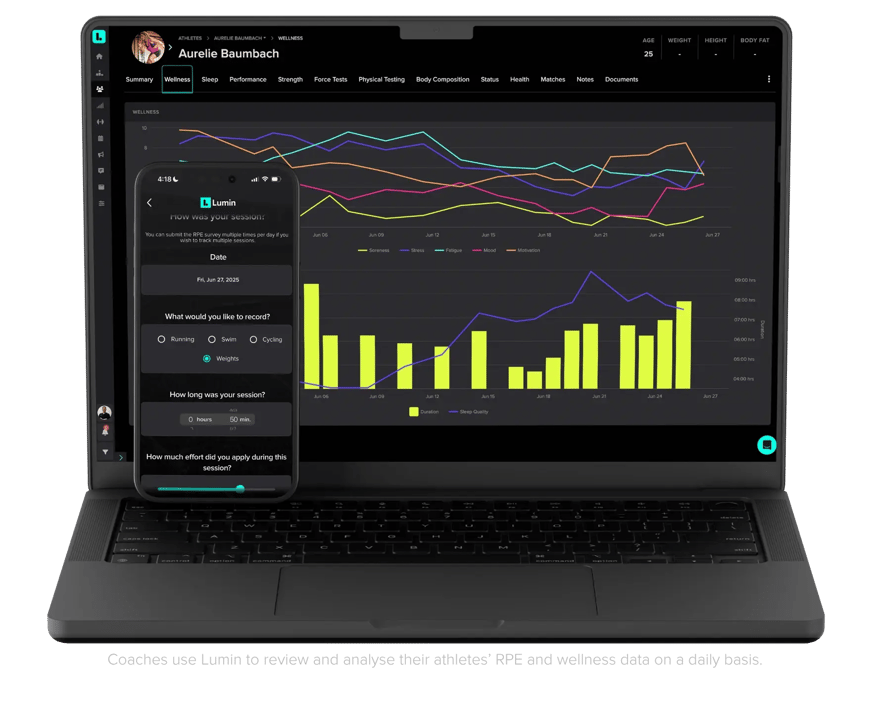
What is starting to emerge is a more unified approach. In platforms like Lumin and other AMS providers, communication, feedback, and individual context sit alongside training. Coaches can capture notes, adjust sessions for specific athletes, and keep track of wellbeing without losing sight of the overall program.
''We we're realizing that athletes needed a lot more wraparound support from the point of view of tracking wellbeing, sleep, and GPS data,'' said Keith Lesslie, Assistant Coach at Birkenhead United.
''We were collecting that in a variety of different forums but to have something there that we could bring it all together into one common data environment was something that was really attractive.''
It is a subtle shift, but an important one.
The environment begins to reflect the reality of coaching, where performance, wellbeing, and communication are not separate workflows, but part of the same conversation.
Bringing It Together
None of these pillars are new. Physical literacy, testing, progressive loading, and athlete centred coaching have been part of LTAD conversations for years.
The gap is not in understanding what matters but it's in whether the environments coaches work in actually support those behaviours.
A new generation of platforms are starting to close that gap. Not by redefining LTAD, but by making it easier to apply.
Ultimately, that is where LTAD succeeds or fails. Not in the framework itself, but in whether coaches can bring it to life, session after session, athlete by athlete.